Keeping a Habit While Traveling: Pack the Cue, Not the Gear
You packed the shoes, the band and the good intentions. You left the one part that actually started the habit sitting on the kitchen counter at home.
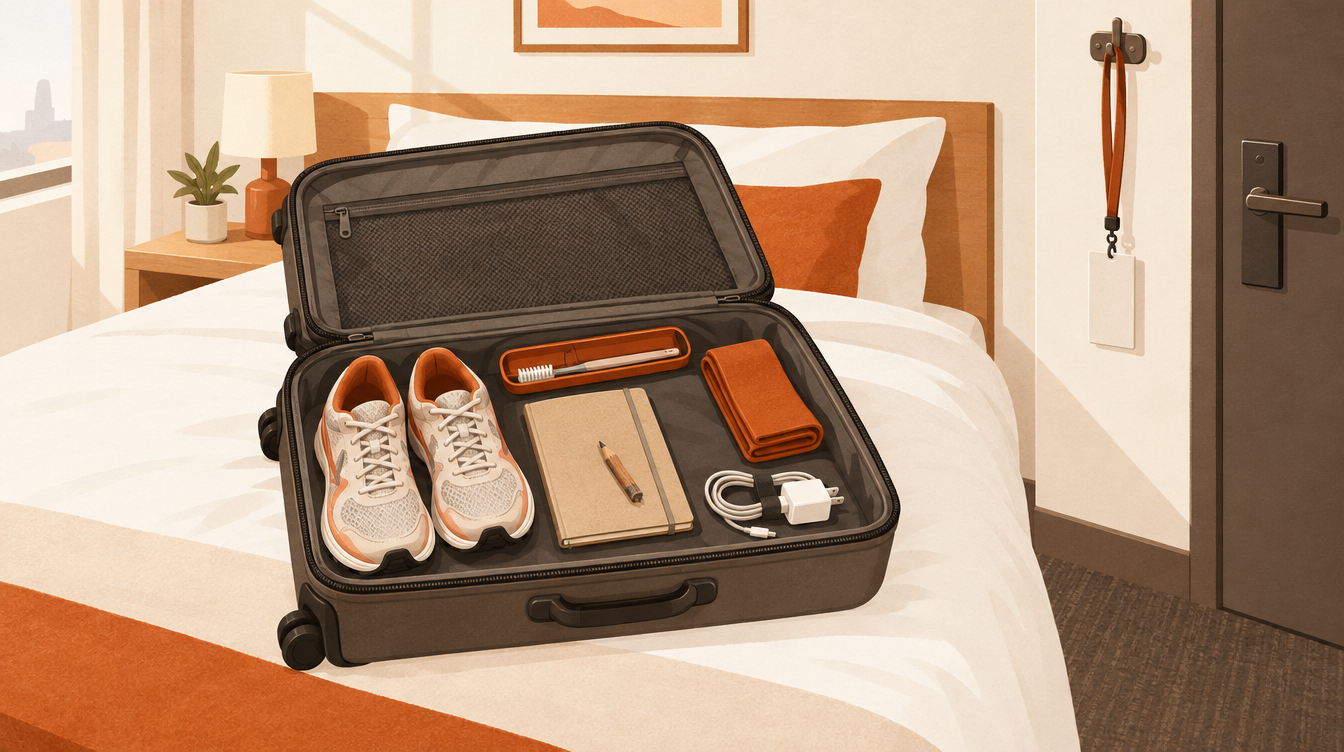
You packed for the habit. Running shoes, the resistance band, the little notebook, a pencil, all laid out in the suitcase like surgical instruments. You were going to keep it going this time. You told someone so.
Five days later the shoes have been worn once, to dinner. The band is still folded in its pouch. The notebook has one entry, written on the plane, and it says “Day 1.”
The problem
Common signs:
- You packed every piece of equipment the habit uses and none of the moments that start it.
- At home the habit happens “after the kettle” or “when I get in from work,” and on the trip there is no kettle and no getting in from work.
- It survived a weekend away and died on a ten-day trip, or survived the hotel and died at your parents’ house.
- You kept meaning to do it “sometime today,” and today kept happening in a different order.
- The first morning after a long flight, you were awake at four and asleep at three in the afternoon, and the habit’s time slot was in neither.
Why the gear is the wrong thing to pack
I have written about trips before, mostly about keeping a travel version small and restarting fast. That advice stands. This one is about the part people skip, which is the part that switches the habit on.
Habits travel when part of the old setting travels with them. In a study of students transferring to a new university, habits like exercising or reading the paper held up when key parts of the setting stayed similar, and were disrupted when they changed [1]. When the setting changed, the behavior went back to being guided by intentions, which is the polite way of saying it went back to depending on whether you felt like it. A trip is a small version of a transfer. The useful question is not “what do I need to do the habit?” It is “what part of home starts the habit, and can I bring it?”
Time and routine cues both work at home. In a randomized trial, 192 adults building a daily nutrition habit linked it either to a routine (“after breakfast”) or to a clock time; both built automaticity about equally well over 84 days [2]. A 2026 meta-analysis of 14 studies with 6,069 people found the same pair, consistent timing and consistent routine, were the cue types linked to how much people actually exercised, while a consistent place mostly went with how automatic exercise felt [3]. The links were small and the studies observational. I mention the place finding because it should cheer you up: you did not lose the habit because the hotel gym is grim. The hotel gym is grim. That was never the broken part.
Crossing time zones breaks clock cues first. The CDC describes jet lag as a mismatch between your body clock and local time, usually after crossing more than three time zones, with poor sleep, daytime sleepiness and slower thinking among the effects [4] [5]. Its advice is to follow the destination’s sleep and waking routine on arrival. That has a quiet implication for habits. “Seven o’clock” on your phone and seven o’clock in your body are two different appointments for a few days, and a habit bolted to the clock will turn up at one of them while you are at the other. A habit bolted to brushing your teeth turns up whenever your teeth do.
A missed day is not the end of the part. In a study of 96 people building new habits, missing a single opportunity did not materially affect how the habit formed [6]. The same study put the median time to automaticity at 66 days, with a range from 18 to 254, so do not let a trip convince you the habit was weaker than it was. It was just unplugged.
Possible explanations
These are suspects, not a verdict. A trip can knock out more than one part at once.
The cue stayed home
The diagnosis: your habit was bolted to something that does not exist on the trip. The kettle, the commute, the hook by the door, the dog asking to go out. At home it looked like discipline. It was a kettle. I am very fond of kettles, and I would not ask one to work remotely.
You tied it to a clock that moved
The diagnosis: “at 7 a.m.” worked for years and fell apart in a city eight hours away, or even one hour away on a bad night. Clock cues are excellent until the clock and your body disagree, and on a long trip they disagree for days. You did not lose the habit. You lost the appointment.
Someone else is running the house
The diagnosis: you are staying with family or friends, and their day has a different order. Breakfast is at nine, the bathroom is shared, and the only quiet room is the one with the fold-out bed in it. I have written about other people’s schedules breaking a routine, and a holiday visit is that problem with a guest towel.
You packed a plan, not a version
Be honest about this one. The travel plan was the home plan with a suitcase around it: the full forty minutes, the full program, the notebook with columns. You enjoyed packing it. I enjoy packing too; I own one pencil and I still check it twice. But a plan that needs a quiet hour and a mat will lose to a conference schedule every time, and it will lose on Tuesday first.
A fictional example
This is an illustrative example, not a real person’s story.
Priya does ten minutes of physical therapy exercises for her knee every morning “while the kettle boils and the tea steeps,” a cue she set up with her physical therapist and has kept for months. She flies across the country to stay with her sister for a week. Her sister drinks coffee from a machine that takes forty seconds. Priya’s exercises happen on the first morning, out of guilt, and then not again. On the flight home she blames the trip, the fold-out bed and her sister’s dog, in that order.
Nothing was wrong with the exercises or the knee plan. The kettle stayed in Priya’s kitchen. Before her next trip she picks a new anchor that exists everywhere she goes, brushing her teeth in the morning, and tries it at home for three days before leaving so the new bolt is already tight when she arrives somewhere strange.
One adjustment to test
Before your next trip, write down the one event that starts your habit at home, choose a travel event that will stand in for it, and practice the new pairing for three days before you leave. Change nothing else: not the habit, not the gear, not the size beyond what fits a hotel room.
While the kettle boils
After brushing your teeth
When I get in from work
First time you sit on the bed after coming in
At 7 a.m. on the dot
After getting dressed, whatever the clock says
Shoes on the hook by the door
Shoes by the bathroom door
The full session
The minimum, done right there
Pick the stand-in from things that happen wherever you sleep: brushing your teeth, the first drink of the day, getting dressed, the first time you sit on the bed after coming in. Avoid clock times if you are crossing more than three time zones. Write it as an if-then plan: “After I brush my teeth in the morning, I do the five-minute version, right there, before I leave the bathroom.” That is the whole work order.
Then the Tuesday test, travel edition: picture the worst ordinary day of the trip. The red-eye, the delayed connection, the morning you wake in a strange bed with someone else’s alarm going off down the hall. Do you still brush your teeth that day? Of course you do. Then the cue survives. Can you do the minimum in the time it takes the tap to run warm? If not, shrink it until you can. If the minimum doesn’t embarrass you slightly, it’s too big.
Observation prompt
A line a day for the trip and the first three days home. Nothing else.
| Day | Did the stand-in cue happen? | Did the habit follow it? | Where were you? | If not, what got in the way? |
|---|---|---|---|---|
| Day 1 | ||||
| Day 2 | ||||
| Day 3 | ||||
| Day 4 | ||||
| Day 5 | ||||
| Home 1 | ||||
| Home 2 | ||||
| Home 3 |
Do not add a column for how you felt about the trip. I have read a lot of travel logs. The feelings column always fills up first and tells me nothing about the cue.
How to review
Read the notes, not your memory of the trip. Memories of trips are mostly food.
- If the cue happened and the habit followed it on most days, the stand-in works. Keep it as your travel cue for every trip, and write it on the packing list next to the charger. Do not swap it for something fancier next time. I mean it.
- If the cue happened but the habit did not follow, the bolt is fine and the size is wrong. Shrink the travel version until it fits inside the cue itself, then try again on the next trip.
- If the cue itself did not happen, you picked a stand-in that only exists at home after all. Choose one that is truly universal; teeth have never let me down.
- If it worked away and fell apart at home, your home cue is now the weak part. Go back to it on day one, or keep the travel cue for good if it turned out to be sturdier. Some people discover the travel cue was the better design all along. That is not a failure. That is a free upgrade.
- If it worked on the trip but you resented every minute, that is data too. Look at the reward before you look at the cue.
When to check with a clinician. If you are doing exercises prescribed for an injury or condition and travel makes them painful or impossible, check with the clinician who prescribed them before changing them. If jet lag or poor sleep lasts well beyond the trip, if low mood or exhaustion persists for weeks after you get home, or if you have a long-term condition affected by travel, talk to your doctor. Medication timing across time zones is a question for a doctor or pharmacist, not a habit plan.
If the trip is over and the habit has already lapsed, see how to restart without designing a whole new routine.
Frequently asked questions
How do I keep a habit going when I travel?
Find the cue that starts the habit at home and choose a travel equivalent before you leave, ideally a routine you will definitely do away from home, such as brushing your teeth or your first coffee. Shrink the habit to a version that needs no equipment. Research on context change suggests habits hold up best when part of the original setting comes with you.
Is it better to tie a habit to a time or to a routine when traveling?
At home, a randomized trial of 192 adults found routine-based and time-based cues worked about equally well. Across time zones, though, the clock moves and your body takes time to catch up, so a routine anchor such as brushing your teeth is usually easier to carry. That is a reasonable inference rather than a tested result.
Does missing a few days on a trip ruin a habit?
Usually not. In a study of 96 people forming new habits, missing a single opportunity did not materially affect the habit-forming process. A long gap needs a more deliberate restart, so plan the first day back before you leave.
Why do my habits fall apart when I stay with family?
Because someone else's house runs on someone else's schedule: different meal times, a different bathroom, no hook by the door. The cues your habit relied on are gone or move around. Choose a cue that happens in their house as reliably as yours, and keep the habit small enough to fit around their day.
Sources and further reading
- Wood, Tam and Witt — Changing circumstances, disrupting habits
Journal of Personality and Social Psychology, 2005;88(6):918–933. Students transferring universities; habits were maintained when aspects of the performance context stayed similar and disrupted when they changed. DOI: 10.1037/0022-3514.88.6.918.
- Keller et al. — Habit formation following routine-based versus time-based cue planning: a randomized controlled trial
British Journal of Health Psychology, 2021;26(3):807–824. 192 adults building a nutrition habit over 84 days; routine-based and time-based cues worked similarly. DOI: 10.1111/bjhp.12504.
- Zhu et al. — Not all cues are equal: a systematic review and three-level meta-analysis of context consistency, physical activity and habit strength
Applied Psychology: Health and Well-Being, 2026. Systematic review and three-level meta-analysis of 14 independent studies with 6,069 participants; only temporal and routine consistency were significantly linked to physical activity, while place consistency was linked to habit strength only. DOI: 10.1111/aphw.70204.
- Centers for Disease Control and Prevention — Jet lag (Travelers' Health)
US government guidance for travelers: jet lag is a temporary sleep problem that usually occurs after crossing more than three time zones; advises following the destination's sleep and waking routine on arrival and gives tips before and during travel.
- Riedy and Williams — Jet lag disorder (CDC Yellow Book 2026)
CDC Yellow Book: Health Information for International Travel, 2026 edition, chapter for clinicians. Describes jet lag as a temporary desynchronization between the internal clock and local time, with sleep disturbance, daytime sleepiness and cognitive effects, and lists planning, in-flight and arrival strategies.
- Lally et al. — How are habits formed: modelling habit formation in the real world
European Journal of Social Psychology, 2010;40(6):998–1009. 96 participants over 12 weeks; median 66 days to reach automaticity (range 18 to 254); missing one opportunity did not materially affect habit formation. DOI: 10.1002/ejsp.674.
Sources checked October 29, 2026. This is an editorial summary, not a systematic review or individual advice.